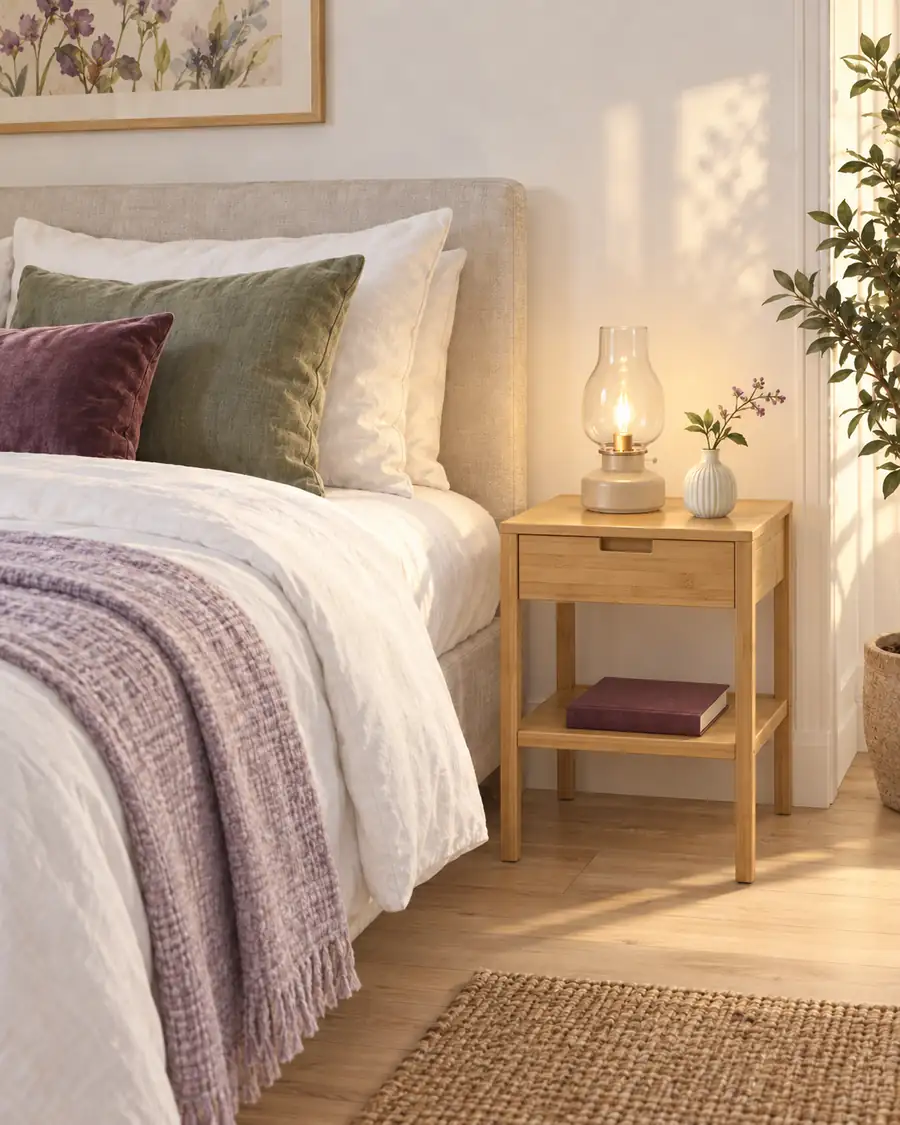
A bedside table can be small and still do too much. The lamp takes the back corner, yesterday’s glass takes the front, and a stack of books leaves nowhere for your glasses. Before replacing it, decide what needs to stay within reach when you are actually in bed.
Build the setup around that short list, the height of your mattress and the space needed to get in and out. A drawer, an open shelf and a wall-mounted ledge solve different problems. This guide helps you choose the useful one, then make it feel like part of the room.
1. Keep the things used from bed
Gather a normal evening’s essentials: perhaps a book, glasses, water and a phone. Your list may include other items. Lay them out at their real size, including charging plugs or a glasses case. This gives you a more useful brief than searching for the narrowest table.
Move spare cables, finished books and tomorrow’s paperwork to their existing homes. If something must remain beside the bed for your own care or accessibility needs, give it priority in the layout. Decorative pieces can use the space left after the routine works; they do not get the first claim on the surface.
2. Measure the gap, mattress and moving parts
Measure the gap from the outside of the bed frame to the nearest obstruction. Include a projecting headboard, radiator, baseboard or curtain. Record depth separately: a table can be narrow enough yet extend into the route you use around the foot or side of the bed.
Measure from the floor to the top of your mattress with the bedding normally in place. Use that as a reference, then trial the proposed tabletop height from both sitting and lying positions. You should be able to retrieve what you need without an awkward stretch. There is no universal height difference that suits every person and bed.
Open nearby wardrobe doors and pull out under-bed drawers. Check their full movement, including the space you occupy while using them. Also find the outlet and trace where plugs and cords will go. A table should not make a frequently used socket inaccessible.
3. Choose between a drawer, a shelf and a ledge
Start with the item that is hardest to store. Loose small things benefit from a contained place. One current book might be happier on an open shelf. A tiny ledge may hold glasses but cannot quietly inherit the work of a full bedside cabinet.
| Format | What it does well | What to test |
|---|---|---|
| Drawer and shelf | Contains small items while keeping one book visible. | Drawer opening direction, usable interior and knee clearance. |
| Open side table | Keeps a small number of essentials easy to see. | Whether the surface still works after adding a lamp. |
| Wall-mounted ledge | Can free the floor when the wall supports installation. | Mounting permission, rated load and reach from the bed. |
| Existing small cabinet | May solve the problem without a new purchase. | Height, depth and whether doors remain usable here. |
4. Compare a real footprint with your gap
The smaller NORDKISA in our gallery is listed at 15¾ inches wide, 15¾ inches deep and 26⅜ inches high. Its drawer is accessible from both sides. That makes the direction of access part of the layout: check the side you will use against the bed frame and wall, not only the cabinet’s closed outline.
Here is a fictional fit check. An 18-inch gap beside a bed leaves 2¼ inches after subtracting a 15¾-inch table. That remaining width is not proof that you can open a drawer or make the bed. If the mattress top is 25 inches high, the listed tabletop is 1⅜ inches higher; trial that relationship before calling it comfortable.
Use a cardboard footprint to check the floor area. For height and reach, a stable surface already in the room can help you compare positions without balancing objects into a makeshift tower. Keep the actual purchase conditional on opening, reach and cord checks.
5. Reserve the working surface before styling it
Place paper outlines of your essentials on the proposed tabletop, then add the lamp base. Leave a clear set-down spot toward the side you use. If lifting a glass would mean reaching around a shade or moving a book, reduce the display or compare a different lighting shape.
The linked TÄRNABY lamp has a 6-inch base, a 10-inch overall height and a 5-foot-11-inch cord. Its bulb is separate; IKEA specifies a dimmable E12 LED and lists a 6-watt maximum. Check the exact bulb and lamp instructions when buying. An existing lamp is worth trialing first.
Treat a warm decorative lamp and a useful reading light as separate decisions. Look at the page from your normal position, check for glare, and see whether you can reach the switch. The room scene is a styling starting point; it cannot establish that a particular light will suit your reading task.
6. Give small things a return place
Use one shallow container you own inside the drawer for the little objects that otherwise scatter. Test whether you can see and retrieve each item. Filling the drawer to its rim makes a small piece of furniture feel smaller, especially when a cable has to pass through the same area.
Route cords where furniture movement will not pinch them, following the electrical product’s instructions. Leave enough slack for the actions you perform, and check the route again with the drawer open and closed. Do not let a neat-looking cable arrangement pull a lamp toward the table edge.
Keep the open shelf for a deliberate small group, such as the book currently being read. A low stack is easier to return than an assortment of unrelated items. In a shared bedroom, choose each person’s storage from their routine; matching tables are optional.
7. Add warmth, then do the lights-out test
Repeat one material or color already present in the room. Bamboo with white bedding and a muted lamp gives the gallery its warmth; you can make the same connection with your existing wood finish or a favorite small object. Leave breathing room around the useful items.
Try the complete sequence: get into bed, set down glasses, reach the light, retrieve the book and get out again. Repeat on the other side if the bed is shared. If the setup forces you to shift furniture or repeatedly clear the surface, solve that before adding decoration.
Explore the bedside and choose pieces · Build an easy weekly bedroom reset
Use these checks with the proposed layout in place. You can tick each one as you test; selections reset when this page reloads.
Common questions
Can I use different nightstands on each side of the bed?
Yes. Different gaps and routines can call for different furniture. Repeat a color, material or lamp detail if you want the pair to feel connected.
Is a floating shelf always better for a tiny bedroom?
It frees the floor but still needs suitable mounting, permission where relevant and enough usable surface. Test reach, capacity and cable routing before choosing one.
How do I style a nightstand without making it cluttered?
Place the lamp and actual nighttime essentials first. Add one small decorative element only if the set-down spot and drawer access remain useful.
Sources & further reading
- IKEA US: smaller NORDKISA nightstand dimensions and drawer access
- IKEA US: TÄRNABY lamp dimensions and bulb requirements
The linked sources support care, safety or measurement guidance. Suggested routines and planning examples are editorial guidance, rather than product tests.