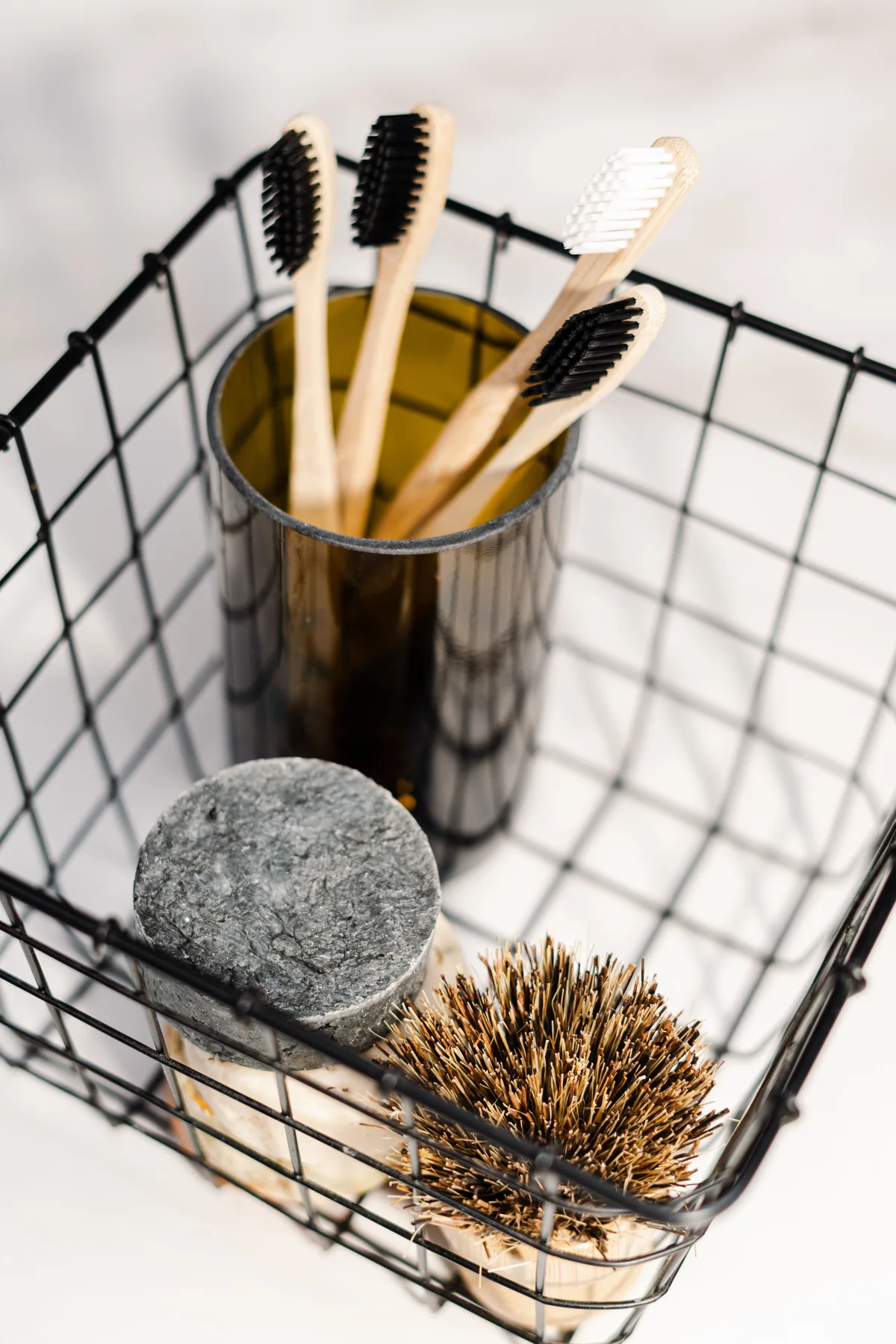
When a bathroom has no drawers, the sink edge often becomes the place for everything: toothpaste, skincare, combs and a spare bottle someone opened. Start by giving the daily routine a return place, even if that place is outside the room.
Use a small washable container, cup or bag you already own where it is suitable. The aim is a kit you can retrieve, a surface you can use and a return step that takes little rearranging. A new tower or wall organizer comes later, if the trial exposes a specific gap.
Stage 1: collect one morning and evening routine
Take only the items used in a normal routine: perhaps toothpaste, face wash, deodorant and a comb. Your list may be different. Keep the products in their labeled packaging and exclude backups from this first group.
Separate shared products from personal ones. Give each person a small kit where needed, and decide where it returns after use before arranging the sink.
Keep wet items separate from a closed dry kit. A freshly used toothbrush needs a suitable drying spot; it should not simply disappear into a zipped bag with everything else.
Stage 2: choose the return place your room supports
Walk through using the basin with the kit in place. Can you reach the tap, wash your hands and set down the item you are using? If a container blocks those actions, being neatly grouped does not make it useful.
A narrow basin rim is not automatically a storage shelf. Test stability with the intended contents and keep the arrangement clear of moving doors. If there is no suitable surface, choose a dry home outside the bathroom and carry the kit in for each routine.
| What you have | First setup to try | What earns its place |
|---|---|---|
| No suitable ledge or cabinet | A portable daily kit on an existing dry shelf outside the room. | It is easy to carry, set down safely during use and return. |
| One small usable counter area | One daily group within that area; backups elsewhere. | The basin and tap remain usable, and the group lifts out for cleaning. |
| An existing shallow shelf or wall cabinet | Daily items at the front in a small removable group. | You can retrieve an item without unloading another group. |
| An under-sink cupboard but no drawers | Separate removable groups that pass through the opening. | The cupboard is dry, pipes and valves remain accessible, and product labels allow that storage location. |
Stage 3: protect a place to set things down
Reserve the clear space you need during the routine. That might hold a face-wash bottle while you use it, rather than a permanent display of every product. Put the daily kit at the edge only if both the kit and this working space fit.
Try the return step immediately. Use a product, put it back and move the kit away. A deep container that swallows small items, a heavy group you avoid lifting, or a lid you need to balance on the basin adds friction. Use a shallower group or divide the routine before adding another organizer.
In a shared room, agree on a return place for each kit. A temporary paper label on the spot may help.
Stage 4: give wet items a drying place
ADA recommends upright toothbrush storage and air drying after use. Give the brush a stable drying holder separate from the closed personal kit, and keep the basin usable.
Keep the towel in use on an existing permitted rail or hook where it can dry. Store clean spare towels separately in a suitable dry location, rather than squeezing them beneath daily bottles.
EPA recommends running the bathroom fan or opening a window while showering to reduce humidity. Dampness is a condition to address, not hide with a basket. Renters should report leaks and moisture problems to the building owner or manager.
ADA: toothbrush care and storage · EPA: bathroom ventilation and moisture control
What can fail in a tiny room
A storage addition needs room for its use as well as its footprint. Try the relevant movement before deciding that an empty corner is available.
| Arrangement | The failure to look for | A smaller first change |
|---|---|---|
| A tall floor unit beside the basin | It crowds your standing space or obstructs a door. | Move backups outside and trial only the daily group. |
| Several little counter containers | Cleaning requires lifting each one; the working area disappears. | Combine compatible dry items into one liftable group. |
| A deep bin of mixed routines | Small essentials disappear under occasional products. | Separate personal kits and remove reserve stock. |
| Over-door storage | The door cannot close freely, or the holder clashes with existing hardware. | Check the full opening and closing swing, including clearance around existing hardware. |
| An adhesive wall organizer | Its surface, humidity rating or loaded weight does not match the instructions. | Check the exact product and finish; keep a portable setup meanwhile. |
Check the exact mounting instructions
For Command adhesive products, check 3M’s guidance and the package for suitable surfaces, weight limits and bathroom compatibility. Follow the exact preparation and waiting instructions, and confirm rental permission. Extra strips do not automatically increase the supported load.
Use a week to decide what is actually missing
During a normal week, notice what keeps landing outside its home. If the kit is always left by the sink, move its return place closer where the room permits, or make the group smaller. If finding one item disrupts everything, change its position rather than adding another shelf.
At the end of the week, clear and clean the usable surface and check reserve stock. Buy only after you can describe the unresolved job: a stable drying holder, a shallow shelf with measured clearance, or a kit with a handle that is easier for you to carry. Keep the rest of the trial setup.
Use the free weekly cleaning checklist for a regular bathroom reset
Common questions
What if there is no counter around the sink?
Keep the daily kit in a suitable dry place outside the bathroom and bring it in for the routine. Do not balance a container on a narrow rim simply to keep everything in the room.
Can a toiletry bag replace a drawer?
It can hold an appropriate dry personal kit. Give wet toothbrushes and towels their own drying arrangements; a closed bag is not the return place for every used item.
Should I install wall storage immediately?
Try the daily-kit arrangement first. If a wall addition solves a remaining gap, check its exact surface, load, clearance and installation requirements, plus rental permission.
Sources & further reading
- American Dental Association: Toothbrushes — Toothbrush Care
- EPA: A Brief Guide to Mold, Moisture and Your Home
- 3M Command: Frequently Asked Questions
The linked sources support care, safety or measurement guidance. Suggested routines and planning examples are editorial guidance, rather than product tests.